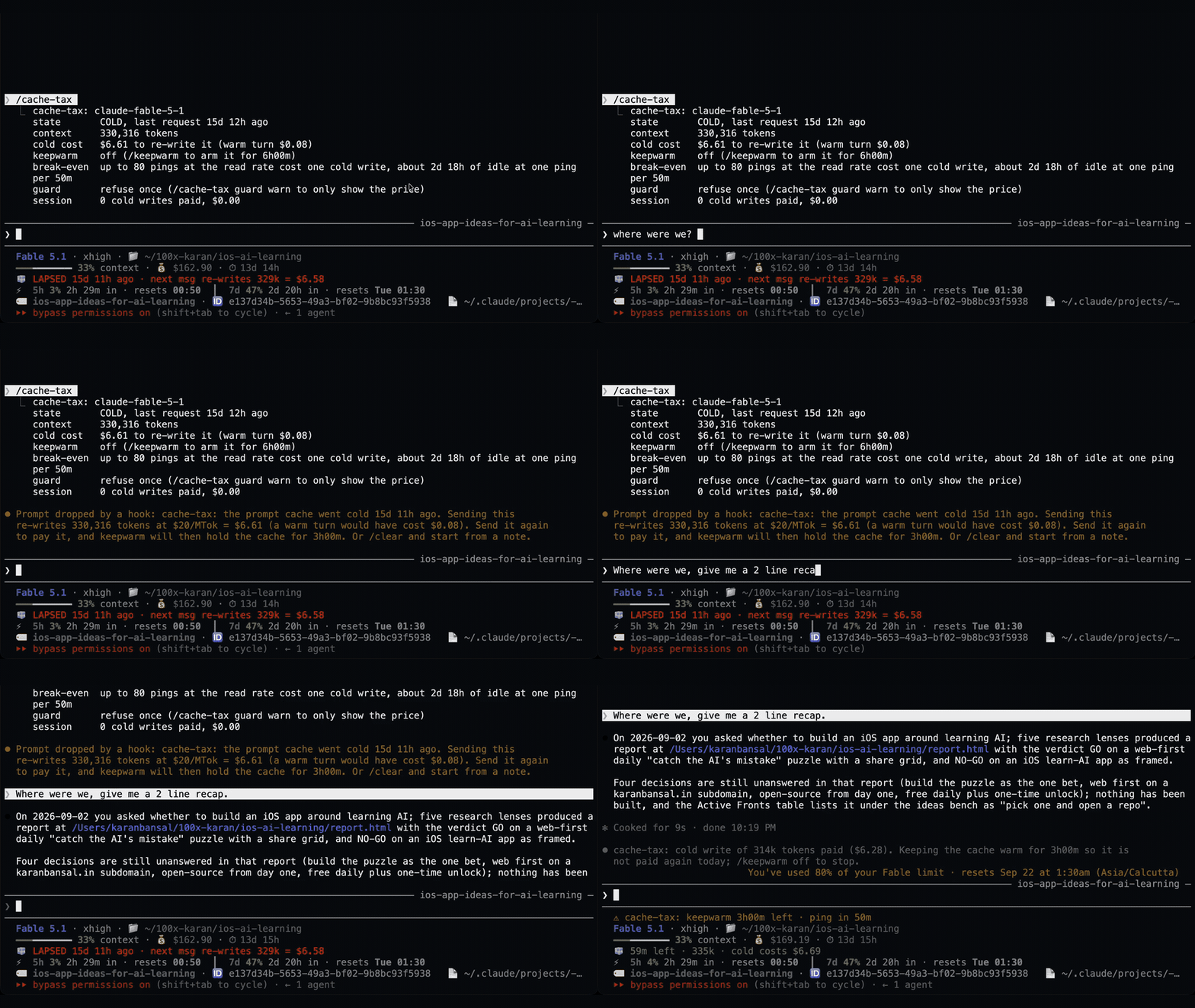
I asked a 330,316-token Claude Code session for a two-line recap. cache-tax stopped the message first and estimated a $6.61 cache write. I sent it again. Claude Code reported 314k cache-write tokens, worth $6.28 at Fable 5.1 API rates, before counting the answer.
Within included subscription usage, that dollar figure is a public cost yardstick, not an extra charge. The practical value is the guard before a cold return and keeping a selected long session cached. Anthropic does not document how cache reads and writes count against plan limits, so I do not claim quota savings.
Why minute 61 is different
Claude Code sends the system prompt, project context, conversation and tool results with each turn. Prompt caching makes the unchanged prefix cheap. A cache hit resets its timer. After the time-to-live expires, the next request processes that prefix again and establishes a fresh cache.
Within included subscription usage, Claude Code gives the main conversation a one-hour cache by default. At Fable 5.1 list prices, a one-hour write is $20 per million tokens and a read is $0.25. That is an 80x difference per cached token.

What you see before a cold send
Both forms watch for an ordinary message after a large context has been idle past its cache lifetime. The hook warns by default. Set CACHE_TAX_BLOCK=1 and it refuses once. The Mod refuses once by default. Slash commands still pass, so you can run /clear and start from a handoff note.
The README example shows the current refusal.
cache-tax: the prompt cache went cold 2h00m ago.
Sending this re-writes up to 200,502 tokens at $20/MTok = $4.01
(a warm turn would have cost $0.05).
Send it again to pay it, and keepwarm will then hold the cache for 3h00m. Or /clear and start from a note.
Resending is unconditional. The guard does not trap you in a loop or silently replace your prompt. Its job is to move the decision to the moment before the expensive request.
The keep-warm loop has to prove itself
The Mod adds the part a shell hook cannot. Run /keepwarm 90m for a short return window or bare /keepwarm for six hours. A timer inside Claude Code waits for 50 idle minutes, then sends one tool-less fork over the session. No heartbeat prompt or answer appears in the visible conversation. A looped hi adds a user turn and a model reply. cache-tax reads the fork's usage and stops when the readback says the cache was already cold.

The 62-minute return
Mock tests can prove the timer and stop rules. They cannot prove that a fork shares the server-side cache. I needed a live run.
On September 19, the main conversation sat idle while a separate background agent kept working. The default ping fired at minute 50, read 157k cached tokens and reset Claude Code's native cache countdown to 58 minutes. My message at minute 62 then read 156,886 cached tokens and wrote 2,255.
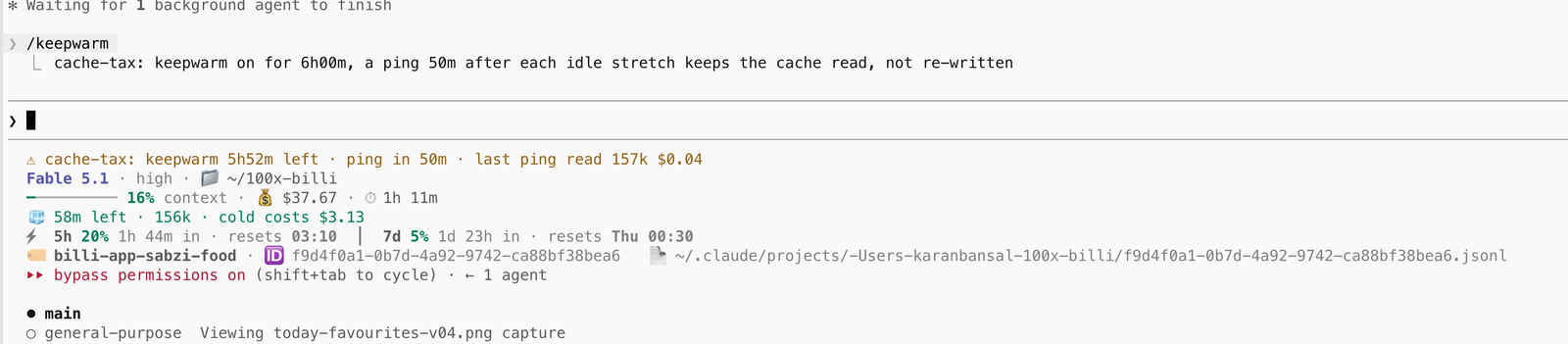
That run proves the session stayed readable past the original hour in this setup. It does not prove net savings for every session. Prefix changes can break the cache regardless of time, and a ping has its own read, uncached input and uncapped output cost.
Use it on sessions you will resume
If the work is finished, let the cache die. Keeping every abandoned session warm wastes tokens. The useful cases are long sessions you plan to return to after lunch, or a main conversation waiting while another agent or workflow finishes.
At Fable 5.1 rates, the read-only upper bound is 80 cache reads for the price of writing the same context once with the one-hour tier. Real pings cost a little more because the fork can answer. This is why cache-tax uses bounded windows and why /keepwarm off exists.
Anthropic documents cache pre-warming as an API pattern for loading a prompt before the real request. The host must remain running for cache-tax. Included subscription usage gives the main conversation a one-hour cache by default. For API keys, cloud providers and usage credits, set promptCacheTtl to 1h; the main conversation otherwise uses a five-minute cache, shorter than the 50-minute timer.
Pick the form you need
Warm the session and guard the return
Use the Mod. It runs inside Claude Code, verifies each ping and refuses a cold send once.
Warn, block or show a countdown
Use the hook. It works without the function-hooks flag and never sends a keep-warm request.
Install the Mod
claude plugin marketplace add karanb192/claude-code-mods
claude plugin install cache-tax@claude-code-mods
If you use an API key, cloud provider or usage credits, add promptCacheTtl to the existing object in ~/.claude/settings.json. Included subscription usage does not need this setting. The setting requires Claude Code 2.1.242 or later.
{
  "promptCacheTtl": "1h"
}
CLAUDE_CODE_ENABLE_FUNCTION_HOOKS=1 claude
In the session you want to preserve, run /keepwarm. The cache-tax page has every command, the validator footprint and the limits.
Install the hook
claude plugin marketplace add karanb192/claude-code-hooks
claude plugin install cache-tax@claude-code-hooks
The hook README includes the optional block setting and the standalone status-line row. Both forms are free, open source and explicit about what they can touch.